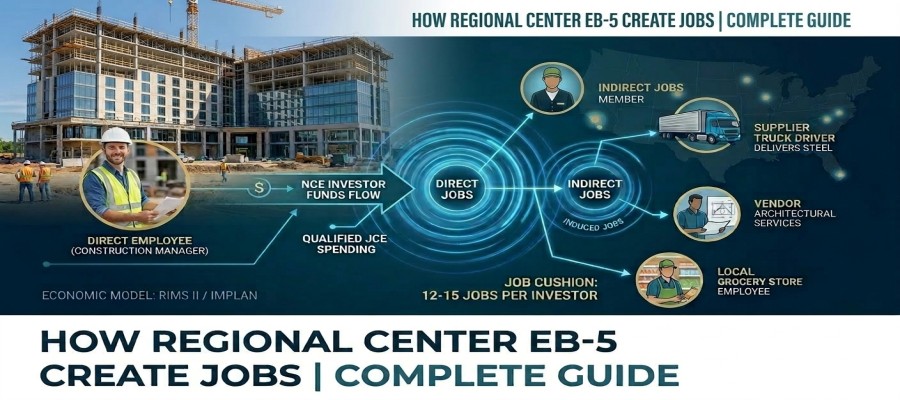
How Regional Center EB-5 Projects Create Jobs
One of the biggest reasons many investors choose the regional center EB-5 path is job creation. In a direct EB-5 case, the investor usually has to show actual employees on payroll. In a regional center project, the process works differently. Jobs are often created through a structured investment model and then measured using accepted economic formulas rather than simply counting workers one by one.
That difference is important. It is what allows large real estate, hotel, infrastructure, and development projects to support many EB-5 investors at once. It is also why the strength of the economic report, the quality of the project budget, and the sponsor’s documentation process matter so much.
The Basic EB-5 Rule
At the center of every EB-5 case is the same requirement: each investor must be credited with creating at least 10 qualifying full-time U.S. jobs. In regional center cases, those jobs do not have to be limited to the employees working directly for the business. USCIS allows regional center projects to use reasonable economic methodologies to show broader job creation in the surrounding economy.
That is the key advantage of the regional center model. Instead of relying only on direct payroll jobs, the project can count multiple layers of economic impact.
The NCE and JCE Structure
Most regional center projects use a two-entity structure.
First, the investor places funds into a New Commercial Enterprise (NCE). This is usually a partnership or LLC created to pool EB-5 capital from multiple investors. The NCE does not usually run the day-to-day business itself.
Then, the NCE deploys that capital into a Job-Creating Entity (JCE), usually through a loan or equity investment. The JCE is the business or project entity that actually spends the money on construction, development, operations, payroll, and related costs.
This structure creates a clear chain between the investor’s capital and the job-generating activity. It also gives the project flexibility to combine EB-5 money with other sources of capital, such as bank financing, developer equity, or mezzanine debt.
What Spending Actually Creates Jobs
Regional center job creation depends on qualified project spending. The economist looks at the project budget line by line and determines which categories of spending can properly be used in the job model.
Typical qualifying categories may include:
Construction labor and materials
Architectural and engineering costs
Project-related professional fees
Operating expenses after opening, such as payroll, supplies, and utilities
Conservative projects usually exclude categories that are more vulnerable to challenge, such as land acquisition, financing costs, or items that may create a risk of double counting. The idea is to focus only on spending that truly drives new economic activity.
This matters because USCIS is not just looking for a big budget. It is looking for a credible connection between actual expenditures and actual job creation.
The Three Types of Jobs in Regional Center EB-5
Regional center projects can generally count direct, indirect, and induced jobs.
Direct jobs are jobs at the project itself. For example, if the project is a hotel, this would include hotel staff on payroll.
Indirect jobs are jobs created at outside businesses that supply goods or services to the project. This might include vendors, suppliers, contractors, and service providers connected to the project’s spending.
Induced jobs are jobs created when workers spend their wages in the local economy. For example, when construction workers or hotel staff spend money at grocery stores, restaurants, and local businesses, that consumer activity can support more employment.
In many regional center offerings, a large share of the total jobs comes from indirect and induced job creation. That is why the economic study is so central to the EB-5 case.
How RIMS II and IMPLAN Work
To estimate these jobs, economists commonly use models such as RIMS II and IMPLAN. These are input-output models that measure how spending in one part of the economy creates ripple effects in other parts.
In simple terms, the model applies job multipliers to qualified spending. If one million dollars of new construction spending in a certain region supports a certain number of jobs, then a project with a much larger qualified budget can support a proportionally larger number of jobs.
For example, if a project has a qualifying construction budget of $100 million, and the model shows that this level of spending supports 1,000 total jobs, then that project could theoretically support 100 EB-5 investors, since each investor needs 10 jobs. In practice, many well-structured projects do not max out the full theoretical capacity. Instead, they build in a cushion.
Why Conservative Assumptions Matter
Because these jobs are modeled, not simply counted on payroll, USCIS pays close attention to whether the methodology is reasonable and whether the assumptions are too aggressive.
A strong regional center project usually takes a conservative approach. That means:
Using realistic spending assumptions
Avoiding inflated budgets
Choosing appropriate industry classifications
Not counting questionable or weak categories of expenditure
Building a meaningful job cushion above the minimum required 10 jobs per investor
This cushion is important. A project that shows exactly 10 jobs per investor leaves almost no room for delays, cost changes, or operational underperformance. A project showing 12 to 15 jobs per investor is usually in a stronger position because it has a buffer if actual results come in below projections.
Job Creation Must Be Proven Over Time
One common misunderstanding is that the economic report is enough by itself. It is not. Regional center job creation must be supported throughout the life of the project.
At the I-526E stage, USCIS reviews the business plan, economic report, and capital structure to determine whether the job creation projections are credible.
At the I-829 stage, the focus shifts to real-world execution. The investor must show that the capital remained at risk and that the project actually moved forward in a way that supports the original job model.
This is why documentation matters so much. Strong projects maintain records such as:
Construction contracts
Invoices and draw requests
Financial statements
Payroll records for operating jobs
Updated economist reports using actual expenditures
In other words, regional center job creation is not just about having a good plan at the beginning. It is about proving, step by step, that the plan was actually carried out.
What This Means for Investors
For investors, understanding job creation is one of the best ways to evaluate the strength of a regional center project. A good project is not just one with a large number of projected jobs. It is one with a clear structure, a credible budget, conservative assumptions, strong documentation systems, and a healthy surplus of jobs per investor.
Red flags may include thin job cushions, unexplained multipliers, overly optimistic budgets, or weak evidence of how the sponsor will track actual spending over time.
Final Thoughts
Regional center EB-5 projects create jobs through structure, spending, and economic analysis. Investor funds move from the NCE to the JCE, the JCE spends the money on qualified project costs, and economists use accepted models like RIMS II or IMPLAN to estimate the direct, indirect, and induced jobs that result.
That is why job creation in regional center EB-5 is not just a math exercise. It is a question of project quality, discipline, and proof. For investors, the safest projects are usually the ones that are not trying to impress with the biggest numbers, but the ones built on careful assumptions, solid documentation, and a conservative path to creating at least 10 jobs per investor.