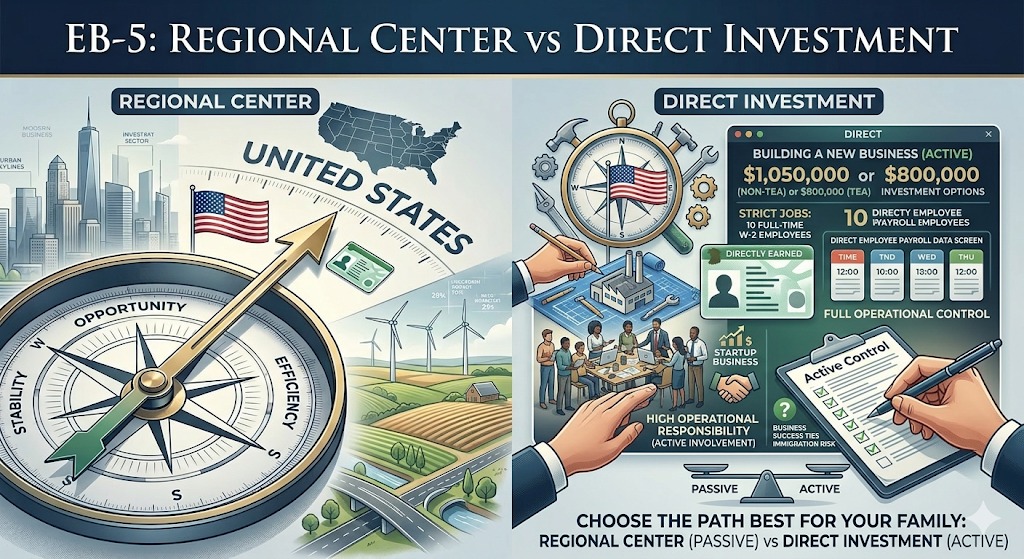
For investors exploring the EB-5 program, one of the most important decisions is choosing between a regional center investment and a direct investment. Both paths can lead to the same outcome—a U.S. green card for you and your family—but they differ significantly in terms of risk, control, timelines, and operational responsibility.
The “better” option is not universal. It depends on how involved you want to be, how much risk you are willing to take, and what your long-term goals look like as a family.
The Core Difference: Passive vs Active Investment
At a high level, the distinction is simple:
Regional Center EB-5 is a passive investment. You invest in a larger project managed by professionals—such as a hotel, mixed-use development, or infrastructure project. You are typically a limited partner, and the regional center handles execution and compliance.
Direct EB-5 is an active investment. You invest in and usually operate your own business. You are responsible for hiring employees, managing operations, and ensuring that your investment meets all immigration requirements.
This difference drives everything else—risk profile, workload, and even the likelihood of meeting job-creation requirements.
Risk: What Can Go Wrong?
Every EB-5 investment carries risk, but the nature of that risk differs significantly between the two models.
In a direct EB-5 investment, your immigration outcome is closely tied to your business performance. You must create at least 10 full-time W-2 jobs, and if your business underperforms—due to lower revenue, hiring delays, or operational challenges—you may fall short of this requirement. For example, if a restaurant planned to hire 12 employees but can only sustain 7, the investor may not qualify for permanent residency.
In contrast, a regional center investment spreads risk across a larger project. Job creation is calculated not only from direct employees but also from indirect and induced jobs using economic models. This often creates a job cushion, meaning each investor may be credited with more than the required 10 jobs. As a result, moderate project underperformance is less likely to jeopardize immigration outcomes.
However, regional center investments introduce a different type of risk: dependency on a third-party developer or sponsor. If the project is poorly structured or mismanaged, it can impact both your capital and immigration timeline.
Control: Who Is in Charge?
Control is one of the most defining differences between the two paths.
With direct EB-5, you are in control. You make decisions on hiring, pricing, marketing, and operations. This can be highly attractive for entrepreneurs who want to build and scale a business in the U.S. But it also means you carry full responsibility for compliance—payroll records, tax filings, and documentation must clearly support your EB-5 petition.
With regional center EB-5, control is limited. You are typically a passive investor with voting rights on major decisions, but no involvement in day-to-day operations. Professional developers and managers handle execution, which is ideal for families who do not want to run a business in the U.S.
The trade-off is clear: more control comes with more responsibility, while less control reduces operational burden but increases reliance on others.
Job Creation: The Critical Requirement
Regardless of the path, every EB-5 investor must demonstrate the creation of 10 full-time U.S. jobs. How those jobs are counted is where the models diverge.
In direct EB-5, only direct employees count—people on your company’s payroll working at least 35 hours per week. This requires careful planning and consistent execution.
In regional center EB-5, job creation includes direct, indirect, and induced jobs, calculated using accepted economic models. This flexibility is one of the main reasons many investors prefer the regional center route.
For example:
A family-owned franchise in a city like Atlanta may only generate 10–15 jobs total, making direct EB-5 a practical fit.
A large hotel development may generate hundreds or thousands of jobs through construction and operations, allowing dozens of investors to qualify under a regional center model.
Timelines and Family Planning
Processing timelines can also influence your decision, especially if your move to the U.S. is time-sensitive.
Recent trends show that regional center petitions—especially rural projects—may benefit from faster processing, sometimes significantly. This can be critical for families planning around school enrollment, business transitions, or relocation deadlines.
Direct EB-5 petitions, on average, may take longer at the initial stage. However, for investors already in the U.S. on visas like E-2, L-1, or H-1B, this may be less of a concern. They can often continue living and working in the U.S. while their petition is pending.
Real-World Scenarios
To make this more practical, consider how different families might approach the decision:
Busy professionals with no U.S. business experience
A regional center investment is usually the better fit. It offers a passive structure, professional management, and a stronger buffer in job creation.
Entrepreneurs who want to build a business
Direct EB-5 is often ideal. It allows full control and aligns immigration goals with business growth—but requires strong execution.
Families already operating a U.S. business
Direct EB-5 may be a natural extension, especially if the existing business can be expanded to meet job creation requirements.
How to Decide: A Simple Framework
When choosing between regional center and direct EB-5, focus on four key factors:
1. Risk tolerance
If you want a safer path for job creation, regional center projects often provide more cushion. If you are comfortable with business risk, direct EB-5 may be suitable.
2. Desire for control
If you want to actively run a business, choose direct. If you prefer a hands-off approach, regional center is the better option.
3. Timeline sensitivity
If speed matters, especially for family relocation, regional center—particularly rural projects—may offer an advantage.
4. Operational capacity
If you have experience and resources to run a U.S. business, direct EB-5 becomes viable. Without that infrastructure, regional center is usually more practical.
Final Thoughts
Both regional center and direct EB-5 investments can lead to the same destination: permanent residency in the United States. The key difference lies in how you get there.
If your priority is simplicity, reduced operational burden, and a more predictable immigration path, regional center EB-5 is often the preferred route.
If your goal is building a business, maintaining control, and actively participating in your investment, direct EB-5 can be a powerful option—provided you are prepared for the responsibilities that come with it.
Ultimately, the right choice is the one that aligns with your family’s risk profile, lifestyle, and long-term vision.