Effective today, March 30, 2026, USCIS has formally changed the order in which EB-5 investor petitions are processed. The new Inventory Management Model - published February 25, 2026, on USCIS's EB-5 Questions & Answers page, ends years of informal, inconsistent sequencing and replaces it with a structured, three-tier adjudication hierarchy. For attorneys counseling investors and for regional centers managing project pipelines, this is not a procedural footnote. It is an operational reset.
This explainer covers three things: what changed and why, how the new hierarchy works in practice, and what it means for clients who are filing - or should be filing - before September 30, 2026.
Section 1: What Changed, and Why
Before today, USCIS processed EB-5 petitions under an informal, loosely applied first-in, first-out (FIFO) approach that was neither consistently followed nor publicly documented. FOIA data obtained by the American Immigrant Investor Alliance (AIIA) confirmed what practitioners already suspected: cases filed around the same date — even in the same TEA category, were being adjudicated at widely different speeds. Some investors received I-526E decisions within months; others with identical filing dates waited years.
The 2022 EB-5 Reform and Integrity Act created statutory obligations USCIS was not structurally equipped to honor under a pure FIFO model. Congress reserved 20% of all annual EB-5 visas for rural projects, 10% for high unemployment areas (HUA), and 2% for infrastructure — but visa utilization data showed these set-asides were chronically underused, in part because USCIS was not sequencing adjudications to align with them.
The February 25, 2026 Inventory Management update is USCIS's formal answer to that structural problem. According to the USCIS EB-5 Q&A page, the Immigrant Investor Program Office (IPO) will now "generally assign Form I-526 and Form I-526E under a first-in, first-out (FIFO) approach that seeks to balance these considerations" statutory set-aside priorities, resource availability, and orderly visa usage. The key word is balance: this is not a pure FIFO model. It is a prioritized FIFO model, where the statutory category takes precedence over filing date when the two conflict.
One additional clarification is critical for practitioners: the Inventory Management Model governs petition processing order only. It does not alter visa allocation, which remains governed by the State Department's monthly Visa Bulletin. Improving adjudication sequencing does not, by itself, accelerate visa issuance a distinction USCIS's announcement conspicuously left unaddressed.
Section 2: The Three-Tier Adjudication Hierarchy
The new model operates in three sequential steps. Understanding how they interact is essential for advising clients on project selection and filing urgency.
Step 1: I-956F Project Approval — The Hard Gate
USCIS will not assign any Form I-526E for adjudication until a decision has been made on the associated Form I-956F the regional center project application. A pending I-956F creates a hard processing hold on every linked investor petition, regardless of the investor's own filing date.
This is now formalized policy, not informal practice. Attorneys whose clients are invested in projects with unresolved I-956F applications must factor this into realistic timeline discussions. Investors whose projects have already-approved I-956F applications gain an immediate structural advantage under the new model.
Step 2: Rural FIFO Priority Queue
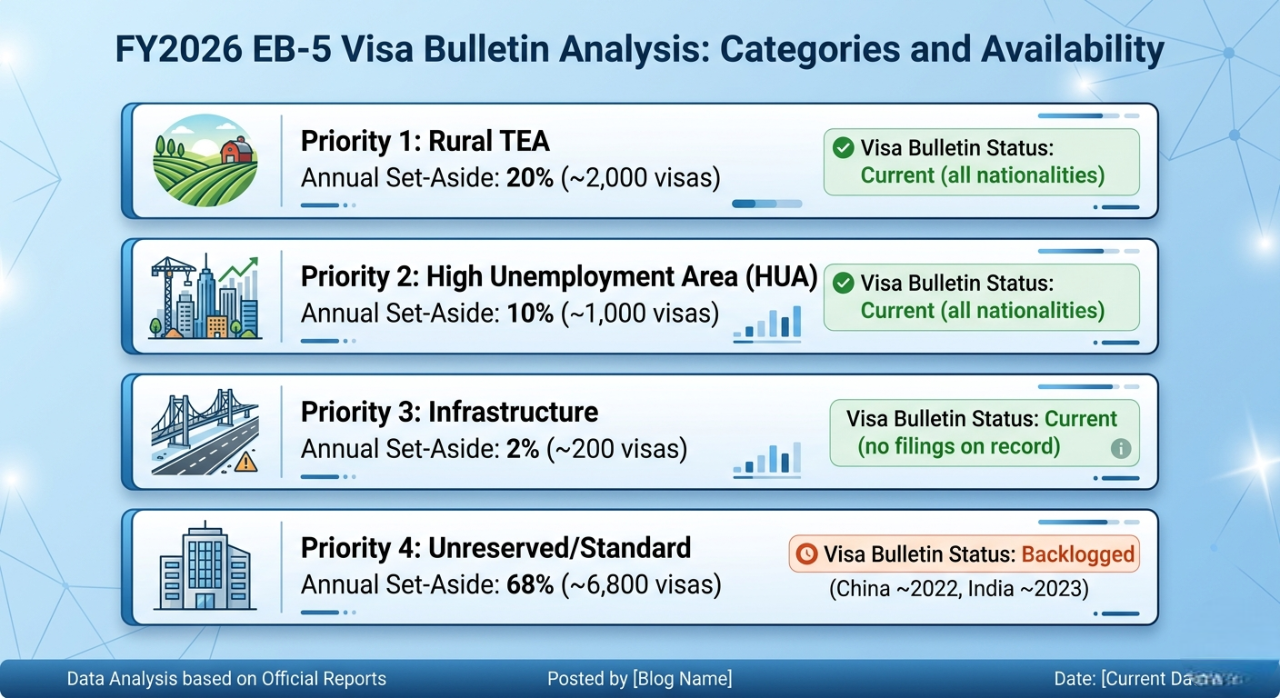
Once the I-956F gate is cleared, rural petitions enter a dedicated FIFO queue and are assigned for adjudication first. USCIS manages this queue specifically to exhaust the 20% rural set-aside (~2,000 visas per fiscal year) before allocating capacity to other categories.
The rural queue "empties" and non-rural cases advance either when the rural visa quota is consumed, or when USCIS determines it has made sufficient rural adjudications. This built-in release valve matters: USCIS retains discretion to advance other categories before the rural quota is literally filled, preventing a rigid bottleneck.
Projected processing timeline for rural petitions with an approved I-956F: 6–9 months.
Step 3: Reserved Sub-Queues and Unreserved FIFO
After the rural queue clears, USCIS groups remaining petitions into sub-queues by visa category, each processed in FIFO order:
|
Priority |
Category |
Annual Set-Aside |
FY2026 Visa Bulletin Status |
|
1 |
Rural TEA |
20% (~2,000 visas) |
Current (all nationalities) |
|
2 |
High Unemployment Area (HUA) |
10% (~1,000 visas) |
Current (all nationalities) |
|
3 |
Infrastructure |
2% (~200 visas) |
Current (no filings on record) |
|
4 |
Unreserved/Standard |
68% (~6,800 visas) |
Backlogged (China ~2022, India ~2023) |
The practical consequence: an HUA petition filed in 2025 can be processed before an unreserved petition filed in 2023. Category designation now outweighs filing date in the processing sequence.
Legacy Petitions Are Unaffected
Pre-RIA Form I-526 petitions (filed before March 15, 2022) remain under the prior processing framework. The Inventory Management Model applies to post-RIA I-526E petitions and the limited set of post-RIA standalone I-526 petitions.
Section 3: What This Means for Clients Filing Before September 30, 2026
The new Inventory Management Model does not change the September 30, 2026 grandfathering deadline — but it dramatically increases the stakes of how that deadline intersects with project selection.
Project selection is now a processing decision, not just an investment decision. Under the old informal model, an investor could choose a project based primarily on financial and immigration merits and accept some processing variability. Under the new model, the I-956F status of the project directly determines when USCIS will even open the investor's file. Attorneys advising clients should now include I-956F approval status as a standard due diligence checkpoint — alongside project financials, TEA designation, and escrow structure.
Rural TEA projects offer the fastest path under the new model. The dedicated rural FIFO priority queue, combined with Current visa availability for all nationalities, means that a rural I-526E petition linked to an approved I-956F project is positioned for a projected 6–9 month processing time in FY2026 — the fastest timeline in EB-5 history for that category. For clients who are also U.S.-based and eligible for concurrent filing, this creates the shortest possible path from filing to Employment Authorization Document (EAD) and advance parole.
Grandfathering protection remains on the floor, not the ceiling. Filing before September 30, 2026 locks in investment thresholds, job creation methodology, TEA designation, concurrent filing eligibility, and statutory protection from program lapse under INA § 203(b)(5)(S). The new Inventory Management Model adds a fourth variable that is now locked in at filing: the I-956F status of the linked project. Clients who file before September 30, 2026 into a project with an already-approved I-956F are grandfathered and immediately eligible for Step 2 queue assignment — the strongest possible filing position.
Urgency is no longer abstract. With approximately 183 days remaining before the September 30, 2026 grandfathering deadline, source-of-funds documentation and project subscription timelines leave little room for deliberation. Attorneys whose clients have been in the "evaluating" phase should treat the I-956F project approval status as the threshold question that moves a conversation from exploratory to actionable.
FAQ: USCIS EB-5 FIFO Inventory Management Model (March 2026)
Q1: What is USCIS's new EB-5 Inventory Management Model?
Effective March 30, 2026, USCIS processes Form I-526E petitions under a three-tier balanced FIFO system: (1) no petition is assigned until the linked I-956F is decided, (2) rural petitions enter a dedicated FIFO priority queue, and (3) remaining categories (HUA, infrastructure, unreserved) are processed in FIFO sub-queues. It replaces the prior informal and inconsistently applied processing approach.
Q2: What is Form I-956F, and why does it matter more now?
Form I-956F is the project application filed by a Regional Center to obtain USCIS approval for a specific EB-5 project . Under the new model, USCIS will not assign any linked investor petition (I-526E) for adjudication until a decision — approval or denial — has been made on the I-956F. A project without an approved I-956F holds every associated investor petition in a processing freeze, regardless of how long ago the investor filed.
Q3: Does this mean investors in rural projects will always be processed first?
Generally yes, with an important qualifier. Rural petitions with approved I-956F projects enter the priority FIFO queue ahead of all other post-RIA petitions. However, USCIS retains discretion to release the rural queue and begin assigning non-rural cases before the rural visa quota is fully consumed — either when the quota is met, or when USCIS determines sufficient rural decisions have been made.
Q4: Does the new model affect the September 30, 2026 grandfathering deadline?
No — the grandfathering deadline under INA § 203(b)(5)(S) is not changed by this processing update. What the new model does is make project I-956F status a more consequential part of the filing decision. Investors who file before September 30, 2026 into a project with an already-approved I-956F gain both grandfathering protection and immediate eligibility for USCIS queue assignment.
Q5: Does this model guarantee faster green card processing?
The model improves petition adjudication sequencing. It does not govern visa allocation, which is controlled by the State Department's monthly Visa Bulletin and is a separate process. An approved I-526E petition still requires visa availability before a green card can be issued. For rural and HUA categories, both are currently favorable — but they are managed by different agencies on different timelines.
Call to Action for Attorneys
If you are advising clients who are actively evaluating EB-5, the single most operationally important question to ask their regional center today is: Has Form I-956F been approved for this project?
Under the model that took effect this morning, I-956F status is now the pacing item for your client's entire processing timeline — not their filing date, not their visa category, and not the sophistication of their source-of-funds documentation.
Georgia EB-5 provides I-956F status confirmation, project documentation, and TEA designation letters upon request. Contact us to confirm your client's project is queue-ready under the new USCIS model.
Sources: USCIS EB-5 Q&A page (updated February 25, 2026, effective March 30, 2026); WR Immigration (Wolfsdorf); Harris Law PA EB-5 Inventory Management Analysis; Behring EB-5 Inventory Management Commentary; Paperfree EB-5 Inventory Management Guide; Lucid Text EB-5 Updates (Suzanne Lazicki); AIIA FOIA data via WR Immigration.