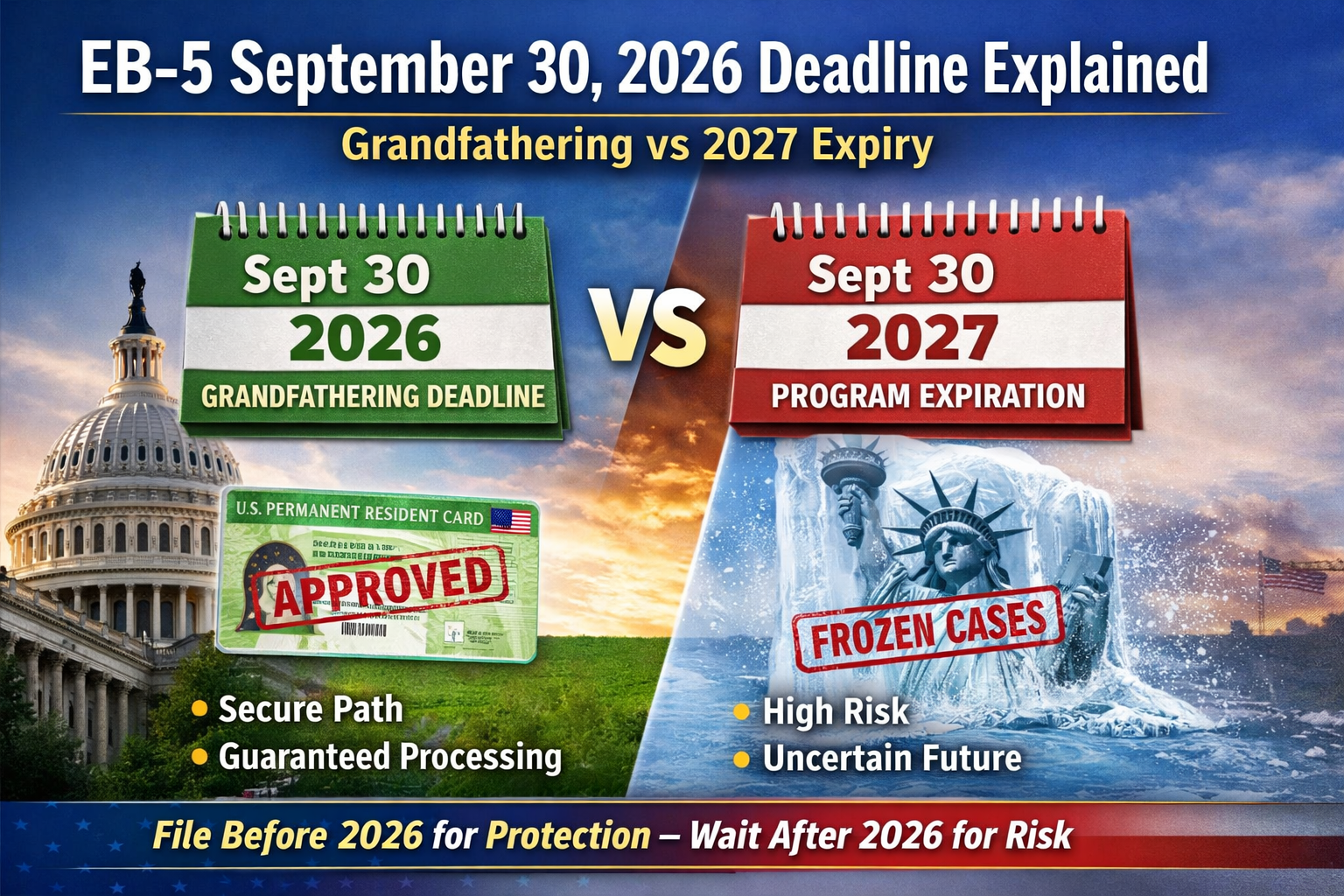
The EB-5 Regional Center Program currently has two critical deadlines that are often misunderstood—but the difference between them can determine whether your green card process is secure or at risk.
- September 30, 2026→ Grandfathering Deadline
- September 30, 2027 → Program Expiration
At first glance, these may seem similar. They are not.
Understanding this distinction is one of the most important decisions an EB-5 investor will make in 2026.
The EB-5 grandfathering deadline in 2026 is one of the most important legal milestones for investors considering the EB-5 visa. With processing timelines, visa availability, and regulatory stability all tied to this date, understanding how the EB-5 program works in 2026 is critical before making an investment decision.
What Is
the EB-5 Grandfathering Deadline?
The September 30, 2026 deadline comes from a provision in the EB-5 Reform and Integrity Act of 2022 (RIA), which introduced a legal safeguard known as grandfathering.
Under this rule:
- Any investor who files Form I-526E on or before September 30, 2026 is fully protected by law
- USCIS must continue processing the petition -even if the EB-5 program expires later
- The investor can complete the full process:
- Conditional green card
- I-829 removal of conditions
- Permanent green card
This is not a policy or guideline - it is written directly into U.S. law under the Immigration and Nationality Act.
What
Happens After September 30, 2026?
Investors can still file between October 1, 2026 and September 30, 2027, because the program remains authorized.
However:
- These investors are NOT grandfathered
- Their petitions depend entirely on Congress renewing the program
- If the program lapses, their case can be frozen or terminated
This is the key distinction:
Filing before 2026 = protection
Filing after 2026 = uncertainty
September 2026 vs September 2027 (Simple Comparison)
|
Factor |
September 30, 2026 |
September 30, 2027 |
|
What it is |
Grandfathering deadline |
Program expiration |
|
Legal protection |
Guaranteed |
Not guaranteed |
|
USCIS processing |
Must continue |
Only if program active |
|
Visa allocation |
Protected |
At risk |
|
Risk level |
Very low |
High |
In simple terms:
2026 locks your protection. 2027 does not.
What Happened in 2021 (Why This Is Real Risk)
Many investors assume the program will always be renewed.
That assumption is wrong.
In June 2021, the EB-5 Regional Center Program expired—and the consequences were immediate:
- USCIS stopped processing all new EB-5 petitions
- Pending cases were frozen
- Adjustment of status applications were rejected
- Interviews were canceled
This situation lasted over 8 months until Congress reauthorized the program in March 2022.
For many families, this created:
- Delays of years
- Financial uncertainty
- Legal complications
The grandfathering rule was created specifically to prevent this from happening again.
What Grandfathering Actually Protects
Most investors think grandfathering only protects against program expiration.
It does more than that.
Filing before September 30, 2026, locks in:
- Investment amount ($800,000 or $1,050,000)
- Job creation rules and methodology
- TEA designation (Rural or HUA)
- Eligibility for concurrent filing
- Visa allocation rights
Even if laws change later, your case continues under the rules at the time you filed.
Real Investor Scenarios
Scenario 1 — Filing Before Deadline (Sept 2026)
- Fully protected
- Case continues even if program expires
- Lowest possible immigration risk
Scenario 2 — Filing After Deadline (Late 2026)
- Case is valid
- But dependent on Congress
- Risk of processing freeze
Scenario 3 — Filing Close to 2027 Expiry
- Highest risk
- No buffer for delays
- Entire case depends on political decisions
Why Waiting Is Usually a Bad Strategy
Many investors delay decisions hoping for:
- Lower investment amounts
- Faster processing
- Better projects
Historically, the opposite happens.
Every major EB-5 reform has:
- Increased investment thresholds
- Added stricter compliance
- Reduced flexibility
Investors who file earlier typically benefit from more favorable terms than those who wait.
Can the September 30, 2026 Deadline Be Extended?
Short answer: No
- USCIS cannot extend it
- There are no exceptions
- No late filing allowed
- Only Congress can change it
And there is no guarantee that Congress will do so.
What Happens If the Program Expires in 2027?
If Congress does not renew the program:
- Pre-2026 investors → Fully protected
- Post-2026 investors → High risk of frozen cases
- Pending applications → Likely paused (based on 2021 precedent)
This is the exact risk grandfathering is designed to eliminate.
Who Should Pay the Most Attention to This Deadline?
This deadline is especially important for:
1. Indian & Chinese Investors
- Already facing visa backlogs
- Rely heavily on reserved categories
2. H-1B / F-1 Visa Holders
- Benefit from concurrent filing
- Want faster stability
3. Families with Children
- Protects against age-out risks
- Locks in eligibility
Timeline: When You Should Start
To meet the September 2026 deadline, investors should begin now.
Typical preparation timeline:
- 6+ months: Project selection + source of funds.
- 3–5 months: Documentation + legal prep
- 1–2 months: Final filing
Source of funds is usually the longest step.
As part of early preparation, investors should begin evaluating projects well in advance. At Georgia EB-5 Investments, we have EB-5 projects in Targeted Employment Areas (TEA) aligned with current program requirements, allowing investors to qualify for the $800,000 minimum investment threshold while also benefiting from reserved visa categories.
Final Takeaway
The difference between these two dates comes down to one thing:
September 30, 2026 determines whether your EB-5 journey is protected or uncertain.
If you file before this deadline:
- Your case is secure
- Your investment terms are locked
- Your path continues regardless of politics
If you file after:
- You are exposed to legislative risk
- Your timeline is uncertain
- Your outcome depends on Congress
“How to Prepare Before the EB-5 Deadline”
- Choose project (Regional Center vs Direct)
- Start source of funds early
- Evaluate TEA eligibility
- Work with EB-5 attorney
If you're considering EB-5, the most important step is understanding your timeline and eligibility.
Schedule a consultation to evaluate your options before the 2026 deadline