Why 2026 Is a Pivotal Year for EB-5 Investors
The EB-5 Immigrant Investor Program has long been one of the most direct pathways for foreign nationals to obtain U.S. permanent residence through investment. In 2026, the program is entering a particularly favorable phase: regulatory rules are stable, reserved visa categories remain widely available, and the U.S. government is implementing new processing systems designed to improve efficiency. For investors seeking long-term residency in the United States, these factors make 2026 a strategic window to consider an EB-5 investment.
Understanding the EB-5 Program
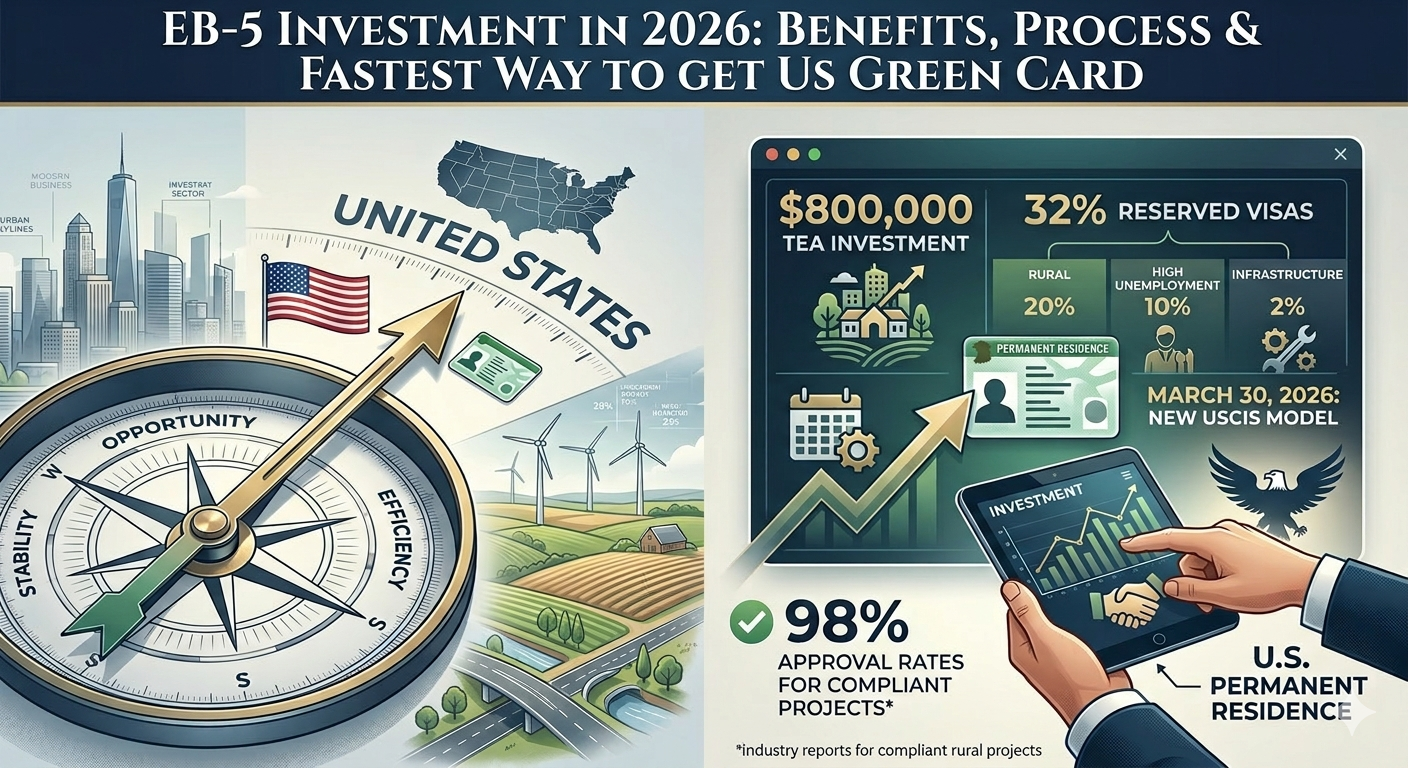
The EB-5 Immigrant Investor Program allows qualified foreign investors to obtain a U.S. green card by making a significant investment in a U.S. business that creates jobs for American workers. In 2026, the minimum investment requirement is $800,000 for projects located in Targeted Employment Areas (TEAs)—which include rural regions or areas with high unemployment—and $1,050,000 for projects outside TEAs.
To qualify, investors must place capital into a new commercial enterprise and demonstrate that the investment will create at least 10 full-time jobs for U.S. workers. Once the investment and petition are approved, the investor and their immediate family receive conditional permanent residency for two years. After demonstrating that the investment has remained at risk and that the job creation requirements have been met, investors can apply to remove the conditions and obtain permanent green cards.
Investors can participate in the EB-5 program through two primary structures. A direct investment involves actively managing a business and directly creating jobs through payroll. Alternatively, many investors choose regional center projects, which allow for a more passive role. Regional centers pool investor funds into large development projects and can count not only direct jobs but also indirect and induced employment calculated through economic modeling.
Reserved Visa Categories Create a Unique Opportunity
One of the most important developments in EB-5 over the past few years came from the EB-5 Reform and Integrity Act (RIA). The legislation introduced reserved visa categories to ensure that certain types of projects receive dedicated immigration visas each year.
Approximately 32% of EB-5 visas are now set aside annually:
20% for rural projects
10% for high-unemployment TEA projects
2% for infrastructure projects
As of early 2026, these reserved categories remain “current” in the Visa Bulletin for most countries, meaning there is little or no waiting period for visa availability. This contrasts with the unreserved EB-5 category, which has experienced significant backlogs for high-demand countries such as China and India.
Because of this structure, many investors are now focusing on rural or other reserved category projects, where visa availability and processing timelines may be significantly faster.
New USCIS Processing Model in 2026
Another major development for the EB-5 program is the introduction of a new USCIS inventory management model, which takes effect on March 30, 2026.
Under this system, USCIS will adopt a balanced first-in, first-out (FIFO) approach while prioritizing rural petitions tied to reserved visa usage. In practical terms, this means that petitions associated with rural projects may receive faster adjudication because the government is actively working to allocate reserved visas efficiently each fiscal year.
For investors considering EB-5, this new model reinforces the growing importance of project selection. Choosing the right category—particularly rural projects—may significantly influence both processing timelines and immigration outcomes.
The EB-5 Process in 2026
The typical EB-5 journey follows several structured steps:
1. Select and fund a qualifying project
2. File Form I-526E, the immigrant petition for EB-5 investors
3. Apply for adjustment of status or immigrant visa processing
4. Receive a two-year conditional green card
5. File Form I-829 to remove conditions and obtain permanent residency
For investors already in the United States on visas such as H-1B, F-1, L-1, or O-1, a strategy known as concurrent filing can be especially attractive. This allows investors to submit their I-526E petition together with an adjustment-of-status application. As a result, they may obtain work authorization and travel documents while the EB-5 petition is still under review.
Strong Approval Trends and Increased Oversight
Since the introduction of the Reform and Integrity Act, the EB-5 program has undergone significant modernization. The law implemented stricter oversight of regional centers, enhanced transparency requirements, and stronger compliance measures to reduce fraud and improve investor protections.
These reforms have contributed to strong approval rates for well-structured projects, with some industry reports indicating approval levels approaching 98% for compliant rural projects and properly documented petitions.
The RIA also introduced important compliance safeguards, including:
Mandatory fund administration or annual independent audits
Disclosure of promoter compensation
Regular investor reporting requirements
Periodic DHS audits of regional centers
While these rules increase regulatory scrutiny, they also create a more stable and transparent investment environment for EB-5 participants.
Timing Matters: The 2026 Strategic Window
Many industry analysts consider 2026 a “sweet-spot” year for EB-5 investment. Several factors contribute to this view:
Reserved visa categories are still widely available.
New USCIS processing policies are being implemented.
Demand for rural projects is rising but has not yet saturated available visa quotas.
Investors filing now may secure benefits under current program protections and regulations.
However, as more investors move into reserved categories—especially rural projects—there is a growing possibility that these visa pools could eventually become oversubscribed. Once that happens, wait times may increase significantly.
For this reason, many experts recommend that investors who are seriously considering EB-5 begin evaluating projects and preparing their petitions sooner rather than later.
Final Thoughts
The EB-5 program remains one of the most direct pathways to U.S. permanent residence for international investors and their families. In 2026, the combination of reserved visa availability, regulatory clarity, and evolving USCIS processing strategies creates a particularly compelling environment for potential applicants.
That said, success in EB-5 depends heavily on choosing the right project and partners. Investors should carefully evaluate regional center track records, job-creation models, capital structures, and exit strategies before committing funds.
For those willing to conduct thorough due diligence and plan strategically, 2026 may represent one of the most favorable entry points into the EB-5 program in recent years.