You
have the capital. You want to move to the United States. You have heard that
the EB-5 visa program can get you a Green Card through investment. So you are
ready, right?
Not quite.
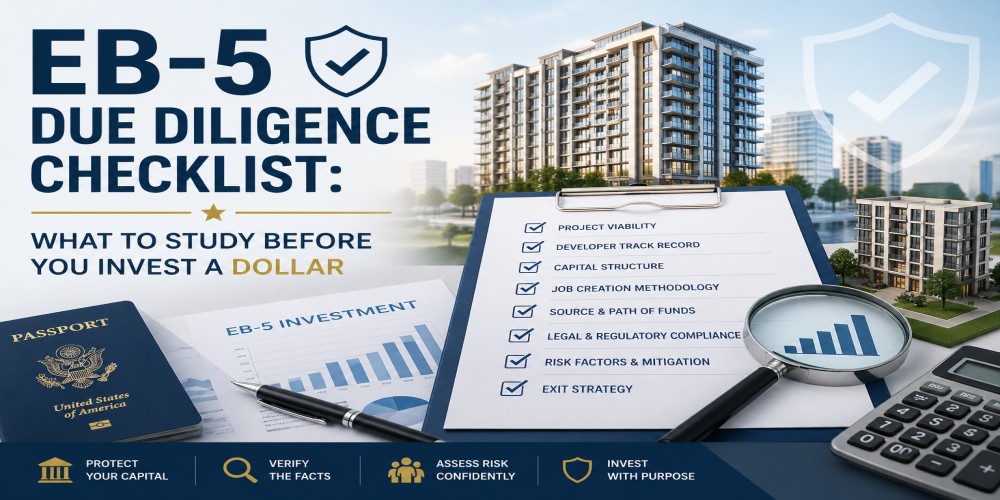
Having the capital is just the starting point. The real work starts with EB-5 due diligence - meaning that you need to study everything about the program, the project and its people before transferring one dollar.
EB-5 is more than just a wire transfer in return for a U.S. Green Card; it is where U.S. immigration laws intersect with real estate finance and job creation requirements. Investors who fail to perform this work upfront end up in processing delays, with denied petitions or losing their money.
This is the checklist I’ve been using for years to analyze rental properties, plan my house flips, and even help newbies so they feel confident with their first few deals.
Why EB-5 Due Diligence Is Non-Negotiable
EB-5 is both an immigration filing and a financial investment. Failing on either side can cost you everything.
A project can make money and still fail from an immigration perspective if it does not meet job creation requirements. And a project can check every USCIS box but still put your capital at risk if the deal is poorly structured.
Once your money is deployed and your I-526E petition is filed, reversing course is extremely difficult. If you are new to this, start by understanding the key factors every investor should evaluate before moving forward.
The Complete EB-5 Due Diligence Checklist
Here are the most critical areas to review before you invest.
1. Verify the Regional Center's Track Record
The regional center is the entity that sponsors the EB-5 project and works with USCIS on your behalf. Not all regional centers are equal.
Check whether it is currently approved by USCIS. Look at how many projects it has completed and how many I-526E petitions have been approved. A strong track record with Form I-956F project approvals is one of the most reliable signals of credibility. Follow this guide to evaluate an EB-5 regional center and verify these details yourself.
2. Understand the Job Creation Model
Every EB-5 investor must be credited with 10 full-time U.S. jobs. Regional center projects typically count direct, indirect and induced jobs using economic models.
What matters most is the job creation buffer. This is the number of excess jobs a project expects to create beyond the minimum. A buffer of at least 150% will allow you a larger safety net if construction gets delayed. Inquire about which assumptions are relied upon by the economic report and if they have been documented to accurately reflect the length of time construction takes to complete.
3. Evaluate the Capital Stack
The capital stack is what finances a project. It’s comprised of the developer
equity, senior loans, and EB-5 investor funds.
A healthy project does not depend entirely on EB-5 capital. The developer should have significant skin in the game through their own equity. Also check where your EB-5 money sits in the repayment order. Senior loan positions offer more security than equity positions. Reviewing completed EB-5 projects can give you a sense of what strong financial structuring looks like.
4. Prepare Your Source of Funds Early
USCIS requires you to prove that your investment capital was earned legally. You also need to trace every dollar from its origin to the EB-5 project account.
If your income comes from a straightforward salary, this step may be simpler. If you own or have an asset ownership interest in a country then source of funds documentation can be very difficult as you will likely have multiple ways the funds were acquired. Start by preparing early and working with an experienced immigration attorney who understands what is expected of you by USCIS.
5. Know What "At Risk" Really Means
EB-5 law requires your capital to be "at risk." This means there can be no guaranteed return or contractual promise of repayment from the project itself.
This does not mean you should expect to lose your money. It means the investment must carry genuine risk, just like any real business venture. Smart investors are ones who know how to manage the risk rather than assuming there is no risk. If you find a good project and with repayment guaranty from developer. That developer can still guaranteed your capital but at mean time still comply the at risk rule.
6. Check the Exit Strategy
Every project should have a clear plan for returning your capital after the investment period ends. Common exit strategies include refinancing, property sale, or developer buyout.
Ask whether the exit plan relies on optimistic market assumptions or conservative projections. Also understand the timeline. While EB-5 capital must stay at risk for at least two years, actual hold periods often stretch to five or more years depending on current I-526E processing rules.
7. Match the Project to Your Timeline
Your immigration timeline matters just as much as the project's financial timeline. Investors from backlogged countries, such as India or China, will need projects that can handle the longer wait.
For now, rural TEA projects will continue to have faster processing, visa set-aside and concurrent filing advantages; if speed is important to you for now, look into some of the new EB-5 projects being designed to maintain this advantage.
Red Flags That Should Stop You From Investing
Walk away from any project that promises guaranteed returns or guaranteed visa approval. Be cautious if the regional center will not share financial statements or prior USCIS approval data. High-pressure sales tactics, vague exit strategies, and developers with no completed project history are all warning signs.
Before you sign anything, make sure you have asked the 10 critical questions every EB-5 investor should ask. If the answers are unclear, that tells you everything you need to know.
Start Your EB-5 Due Diligence Today
You do not need to become an EB-5 expert. But you do need to know enough to ask the right questions and spot red flags early.
The investors who succeed are not always the wealthiest. They are the most prepared. Use this checklist as your guide and take the time to understand what you are investing in before your capital moves.
Visit Georgia EB5 to explore USCIS-approved regional center projects and speak with a team that puts investor education first.