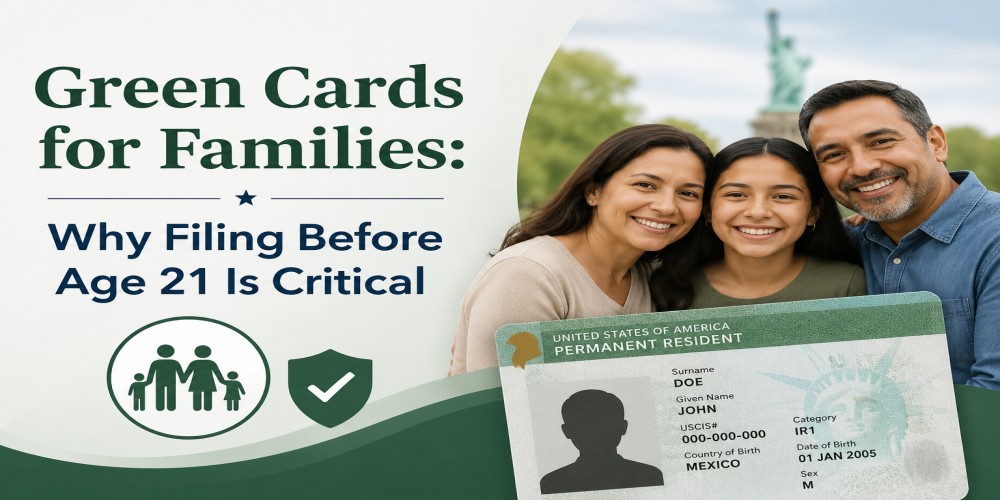
You've spent years dreaming about moving
your family to the U.S. You've finally made the EB-5 investment.
The paperwork is in motion. And then, somewhere between school admissions and a
birthday cake with 21 candles, you find out your child no longer qualifies for
a green card as your dependent. This thing has a name in immigration circles.
It's called "aging out." And honestly, it catches more families off
guard than you'd think.
What Does "Aging Out"
Even Mean?
When you apply for a green card through
EB-5, your spouse and unmarried children under 21 ride along with you as
derivatives. They get green cards too. Once applied, the whole family settles
in. But what happens the moment a child turns 21? They stop being a
"child" in the eyes of U.S. immigration law.
If the green card hasn't been issued
by then, that kid might have to start their own petition from scratch. Or you
can wait years in a separate visa queue. Or worse, miss out entirely. For
Indian and Chinese families especially, this isn't a hypothetical. It's a real,
painful possibility that has split up plenty of households. If you want a
deeper look at why the EB-5 route is still one of the smartest options to
consider, this guide to EB-5 in 2026 breaks it down
nicely.
The Lifeline Called CSPA
Congress saw this problem coming back
in the early 2000s. So they passed the Child Status Protection Act, or CSPA,
for short. Think of CSPA as a clock that pauses.
Here's how it works in plain English:
●
Your child's age freezes the
day you file your I-526E petition.
●
That frozen age is called the
"CSPA age."
●
The clock starts ticking again
once your I-526E gets approved.
So if your kid is 19 when you file,
and approval takes two years, they're "CSPA 19" during that whole
stretch. Their biological age keeps marching on, but for immigration purposes,
time stands still.
Why Filing Early Changes Everything
The earlier you file, the more cushion
you give your child. A 14 year old? Tons of buffer. A 20 year old with eight
months to go? You're racing the clock and praying processing doesn't drag.
This is exactly why immigration
attorneys keep hammering on the same point. Don't wait. Even a six month delay
can cost a family everything. If you're weighing your options or trying to
understand what to look at before committing capital, take a peek at these 10 questions every investor should be asking.
Concurrent Filing: The Secret
Weapon (If You're Already in the U.S.)
Now here's something worth knowing. If
your family is already living in the States, often on an H-1B or student visa, you can sometimes file
your I-526E and your I-485 adjustment of status at the same time.
Because filing concurrently can
permanently lock your child's age. They literally cannot age out once that
I-485 is sitting with USCIS. Done. No more sweating each birthday.
The India and China Problem
Indians and Chinese nationals face
longer backlogs. That's just how the visa bulletin works. And without
concurrent filing, the CSPA clock keeps ticking during the wait, which can age
out kids who looked perfectly safe on paper a few years back.
But there's good news too. The Rural
and High Unemployment set-asides under the RIA of 2022 currently show a current
priority date for both India and China. Which means faster processing. Which
means less aging out risk.
That window won't stay open forever,
though. Backlogs are expected to build, especially in the high unemployment
category. So if you've been sitting on the fence, now is the time to climb
down. Researching the right regional center first? Follow these due diligence steps before
signing anything.
What If My Child Already Aged Out?
An aged out child can sometimes become
an EB-5 investor themselves, especially if their parents gift them the
investment capital. The parents still need to show how the money was earned
originally, but it's a workable route. Plenty of families have rebuilt their
plan this way. The key is moving fast and getting solid advice early.
A Quick Checklist Before You File
So before you submit anything, ask
yourself:
●
How old are my kids today?
●
How long is the projected
processing time for my chosen set-aside?
●
Are we already in the U.S., and
can we file concurrently?
●
Have I done real homework on
the project I'm investing in?
FAQs
1. At what age does a child "age
out" of the EB-5 green card process?
The cutoff is 21. If the green card hasn't
been issued and CSPA protections don't save them, they lose dependent status
the day they hit that birthday.
2. Does CSPA always protect my child?
It depends on when you filed, how long
approval takes, and whether your country has a backlog.
3. Can my child still get a green card
if they age out?
Yes, but it gets complicated. They may need
their own petition, or could become an EB-5 investor through a gift from the
parents
.
4. How do I know which project is right
for my family?
Start with research. Look at completed
track records, future pipelines, and the team behind them.
5. Where can I get personalized advice?
Talk to a real human. You can reach out
here and get specific guidance for your family's timeline.